Richard and Diane Van Vleck Personal Pages
The Home Habitat |
Northern Flicker and European Starling
Nest Box Competition
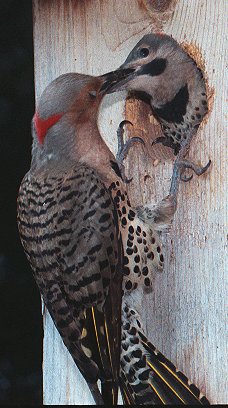 Yellow shafted flickers, although still a common species in the Eastern U.S., have suffered dramatic losses in recent decades. One source claims a 3.2 percent decline per year between 1966 and 1993. Another source claims a population decline of 52 percent from 1966 to 1991. These losses appear to be due to a lack of suitable nest sites. Being weak excavators, flickers need rotting wood of snags and dead limbs to carve out their nesting cavity. Flickers primarily forage on the ground in open areas for ants and other insects. This frequently places them in a starling infested area, while other woodpeckers can take refuge in forested areas.
It has been suggested that Northern flickers are adapting to starling competition by delaying nesting until the starlings have finished and no longer seek nest sites. This has not been my experience. Our starlings begin attempting to nest as early as ever. Woodpeckers are some of the earliest nesters on our property. However, our flickers' first nest sites have been usurped by starlings every time in the past two years. If a flicker pair continues to attempt to nest until mid-June, despite continual harrassment by starlings and the loss of two or more nesting cavities, they may succeed in raising a brood. However, these late broods are less productive than spring broods. Also, survival of fledglings from very late nestings may be decreased, although I have seen no data on this specifically for flickers. All species have evolved an optimum nesting time and dramatically delaying this time will likely have a detrimental effect.
Also, because flickers forage on the ground, in open areas, suburban flickers may be taking a hit from lawn insecticides. This, of course, has a simple fix - don't poison lawn insects, or, better yet, don't have a lawn.
Flicker and starling battles in the nest box
A single battle inside the nest box or cavity between one of the flicker pair and a starling seems to be the cause of nest site desertion. My limited observations suggest that flickers usually hold their own in battles with starlings outside the nest cavity. The flicker and starling clutch each other and fall to the ground, kicking and rolling about. When one has had enough, it simply breaks loose and flies off. But, if a flicker is trapped inside the cavity with a starling wishing to usurp the site, the flicker doesn't have a chance. Starlings are able to severely injure what would seem to be a formidable foe in the confines of the nest box or cavity. Flickers just don't seem to know how to use their powerful beaks in battle. This is likely because they didn't coevolve with starlings.
Recent starling and flicker competition in our yard
2001 A pair of flickers excavated and claimed a cavity in a sycamore in our front yard. Starlings frequently battled with the male flicker as the cavity neared completion. It was only after the male flicker was caught inside the cavity and severely beaten by a starling that the flicker pair gave up and deserted the nest. They then moved to an old flicker box behind the barn. Starlings were also challenging them at this site, but I didn't witness an in-box battle. However, the flickers did desert this site also, before eggs were laid, and moved to a new flicker box just outside my workshop in mid-June. Eggs were laid in this box, but, the pair, again, deserted this box on June 29, when a starling was observed raiding the box. With the flickers not guarding the box, both a starling and a house wren visited the box and destroyed the eggs.
2002 The flickers successfully raised a brood in the same box by the workshop this year. They began nesting in late May, when starling competition was still intense. I tried to monitor this nesting from the workshop and shot or trapped any starling that took an interest in the box. I did witness an in-box fight between the male flicker and a starling. The flicker finally flew from the box, barely able to fly, and didn't return until afternoon, the following day, even though the female called almost continually from the top of the box all morning. As soon as the male left the nest, following this fight, the starling hopped out and perched on top of the box, appearing tired but quite excited. Soon, both starlings were bringing nesting material to the box. I shot one and trapped the other in the box. Luckily the flickers didn't desert the box and successfully raised a brood. Several more starlings were shot on top of the box during this nesting. When the young were half grown, visiting starlings no longer entered the box.
2003 This year, a flicker pair again chose the nest box by the workshop. And, this time, the female was caught inside the box and savagely beaten by a starling. She emerged in great distress and managed to fly away, unable to gain over 4 feet in altitude. I never saw her again that season. The male, who had not witnessed this, called and tapped on the box roof for several days, then finally moved on.
2004 The flickers did not show an interest in the nest box this year. They visited the old cavity in the front yard sycamore, but didn't seem to claim any nest site. I didn't have time for adequate observation this year, but did notice starlings following them around a bit along the fence row trees as well as in the front yard sycamores. I don't think they nested at all in 2004.
2005 This year, two pairs of flickers nested in both the front yard sycamore cavity and the barnyard nest box. Starlings were managed by a combination of extra (decoy) nest boxes near the flicker boxes and continual trapping in the repeating starling traps. The goal was to always have an unoccupied nest box of equal value near the box used by a pair of flickers. During the nesting season, several pairs of starlings are visiting our yard daily, in search of a nest site. The starlings will claim a vacant box before doing battle with flickers. However, once starlings have claimed the decoy box, the next pair will attack the flickers before risking a battle with their own kind. This means starlings claiming the decoy box must be promptly trapped or shot. Also, the repeating traps on our barn have greatly reduced the starling pressure on our flicker boxes. Far more starlings have been caught in these 6 traps than have attempted to nest in the decoy boxes. And most of these were caught in the 4 traps mounted on the barn walls. I didn't use a decoy box in the sycamore tree. However, I did remove two pairs of starlings who claimed the flicker cavity in April. When the second pair of flickers began nesting in the sycamore cavity, no starlings were observed still searching for a nest site. A more detailed chronology of these two 2005 flicker nestings can be found on the 2005 flicker cam page.
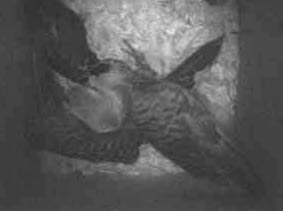
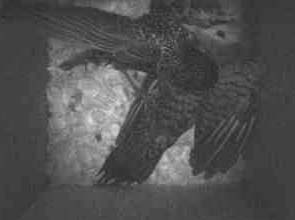 1/6/2009 Today, I witnessed the first flicker vs starling match inside a nest box, in which the flicker won. A male flicker has been roosting each night in a new flicker box on the barn wall. Since the box was put in place, on Dec 5, 2008, a video camera with motion detection on a video capture box has been continuously monitoring the box. The male flicker moved in the first night and has been leaving around 7:30 each morning, returning around 4pm. Yesterday, at 8:14 am, a starling visited the box, removing some wood chips and generally showing signs of claiming ownership. This morning, at about the same time, the starling returned to inspect the empty box. However, this time the male flicker also returned and a great battle ensued. The capture box was programmed to record only one frame per second, so I can't recite every jab and kick, but, in each frame, the flicker appeared dominant. After the starling escaped the box, the flicker remained in the entrance hole for some time. The starling never returned and the flicker is back roosting in the box tonight.
1/23/2009 The male flicker was not roosting in the box tonight, for the first time in weeks.
1/24/2009 A starling roosted in the box tonight. This is the first I've seen a starling use a nest box as a winter roost. I haven't seen the flickers.
1/25/2009 The starling was trapped in the box, using the sliding hole cover. Still no sign of the flickers.
1/28/2009 Another starling visits several times in the morning, often removing several wood chips. This chip removal seems to be a sort of nest selection ritual.
1/29/09 Two starlings visit box together at 8am and make many visits during morning. Often, when a starling visits and removes a wood chip, several starlings are perched in a maple tree 40 feet from the barn, watching the nest box. Again, this removal of a wood chip appears to be a mating ritual to entice a female to accept the nest site.
2/5/09 The male flicker arrives at 5:08 pm and remains in the box all night. However, instead of settling on the floor of the box, he clings to the wall at the entrance hole throughout the night.
2/6/09 The male flicker leaves the box at 7:30 am and a starling visits at 8:08, making many visits until 8:30. At 5:08 pm, the male flicker arrives to spend the night. The exact time of his arrival for the past two nights is surely a coincidence, since, like me, the flicker doesn't own a watch. He, once again, clings to the entrance, rather than resting on the floor.
2/7/09 Male flicker leaves box at 7:17 am. Starling enters at 7:48. Starling exits box and flicker enters at 7:49 and clings to wall at entrance. The flicker returned again at 5:30, clung to wall for awhile, appearing agitated, and then left.
2/8/09 No flicker visits today. Starling visits in am. At 5:00 pm, two male flickers were seen squabling under eaves of barn, where the flicker pair often roosted several months ago.
2/9/09 Frequent starling visits at nest box between 7:23 and 10 am. No flicker visits.
2/10/09 Frequent starling visits 7:29 - 10:00 am. No flicker visits.
2/11/09 7:58 am single starling visit. The video capture box was removed to use at a downy woodpecker box. Two male flickers were squabling over their night roost under the eaves again at 5pm. My presence scared them both off. The female is again roosting under the eaves on the opposite side of the barn. Oddly, all last fall the male and female roosted side by side each night in that location.
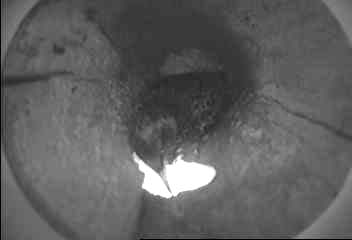 2/22/09 The video capture box was reinstalled at the flicker box and recorded starling visits between 7:21 and 7:58 am., removing several chips, as usual. This same thing has been happening at a box 300 feet away from the barn, where the capture box has monitored two log nest boxes. A starling (photo at right) entered the larger size box each morning and removed one or two wood chips. Something (likely a starling) darkened the entrance hole of the downy box each morning, causing the motion detector to record. A starling is too large to enter the downy box.
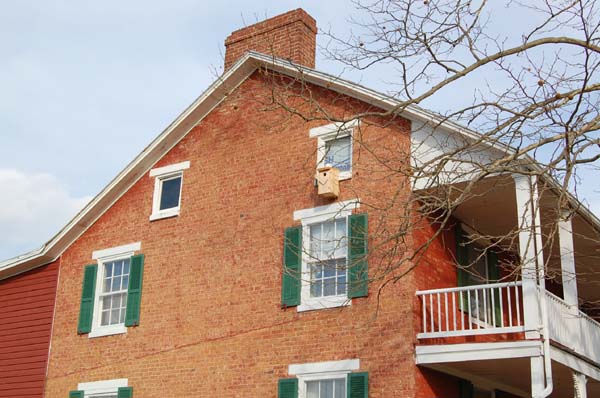 3/22/09 A flicker box has been mounted on the house wall, under an attic window, for easy access. A starling pair immediately began visiting the box and removing one or two chips at each visit.
3/23/09 After frequent AM visits today, a starling remained in the box tonight and was trapped and removed in the dark. Presumably, the mate was unaware of this.
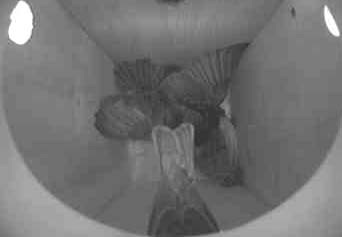 3/24/09 Starlings began visiting the box in early morning, as usual. Then two starlings entered and a fight ensued. A third starling entered and seemed to just observe the battle while clinging to the entrance hole. However, it did drop to the floor several times. It wasn't clear in the series of stills whether the third bird participated in the thrashing. This battle was one sided from the very beginning, as often seems the case. The vanquished bird finally escaped and the new pair resumed their visits.
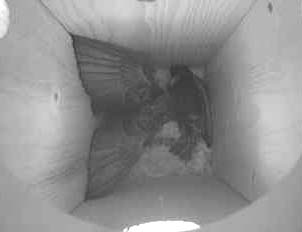 Was the third starling the surviving male of the female trapped the previous night? And, did the new pair appropriate the box? Or did the surviving male replace his lost mate in a matter of hours? The usual brief and predictable daily starling visits to several flicker boxes suggests that individual birds have claimed these boxes. However, all starlings look alike in the videos.
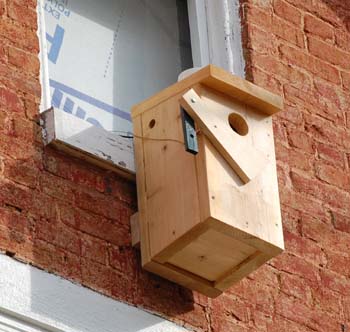 The nest box (photo at right)is fitted with a pivoting hole cover, as are most of my nest boxes. However, rather than using the usual solenoid trip, the attic window location lends itself to a simple string trip. The styrofoam panel seen in the attic window prevents a flicker perched on top of the box from being frightened by my presence near the window. Flickers (especially males) are, by far, the most timid of the species choosing to nest in our yard. They willingly choose to roost under the barn eaves, drum on the tv antenna, and nest in any of the boxes I provide for them, yet they fly off several hundred yards everytime I approach within 100 feet of them. This is especially obvious when I enter the barn at dusk, while they have roosted under the eaves. Flickers were still commonly hunted for food at the turn of the last century, perhaps resulting in this uncommon distrust of humans in a species that chooses to live close to human habitation. Given enough snags for nest sites and open ground for foraging, they might quickly forsake our yards.
4/15/2009 update Starlings have been persistently claiming both flicker boxes and the flickers are seldom seen or heard, but both the male and female inspected the barn box last week, drumming at the entrance, but not entering the box. I have trapped pairs of starlings in both boxes several times, only to observe a second pair take over the box the next morning, and, once, even the same day. And the replacement starlings no longer fool around with the chip removal ritual. They immediately begin bringing grass and building a nest, which I remove each time I trap one. No more starling/starling battles have been recorded. It's almost as if the starlings have taken to communal nesting in the barn box. At the same time, the repeating traps are catching many starlings, frequently two at a time. And, oddly, I never see more than 2 or 3 starlings in the maples in front of the barn nest box. The tv monitor for the barn nest box cam is on the band stand, one floor below the nest box. While watching the monitor, I can also observe birds in the maples through large windows. When a starling enters the nest box, its mate is usually perched in a tree, watching the box. Since this is an interior nest box, the mate can't see me remove the trapped bird and reset the trap. It typically takes from 5 to 15 minutes for the 2nd bird to enter the trap.
This rapid pair replacement surprises me, especially since the two repeating traps at the same end of the barn are catching other starlings. Why do the pairs-in-waiting not enter the traps? And why don't I see more starlings in the maples? It's as if a fresh pair come out of nowhere to fill the void when a pair are trapped at the nest box.
video camera equipment for nest box use
the flicker nest box
2001 flicker nest cam
2002 flicker nest cam
2005 flicker nest cam
2004 nest box trap research - trap modifications and locations
A new nest box trap design
The tipping can starling trap
Providing snags for cavity nesters in your yard
The house sparrow in America
The European starling in America
the pellet gun - a valuable tool in house sparrow and starling control
Making and using blinds in the home habitat
American Artifacts home
email richard@americanartifacts.com
© 2005 - 2009, American Artifacts and Richard Van Vleck, Taneytown, Maryland.