Richard and Diane Van Vleck Personal Pages
The Home Habitat |
Big Brown Bat
Eptesicus fuscus
From barn to bat house - a tentative success story
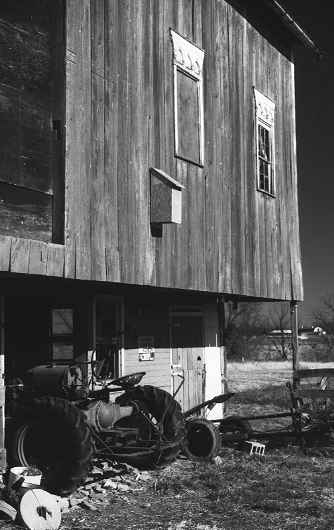
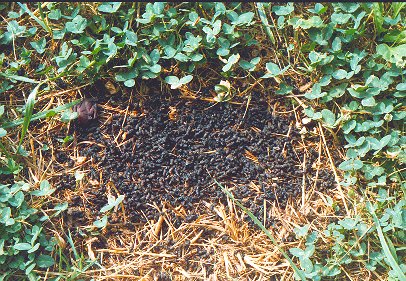
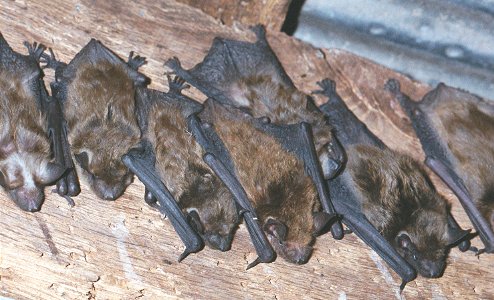 Feb 2001 Update - The bat box on the barn was used both in 1999 and 2000 as a nursery for big brown bats. In early fall of 1999 and again in late summer of 2000 big brown bats invaded the interior of the barn en masse! The upper barn is filled with antique tractors, machines and tools, with very little space to move. When the bats decided to move inside, almost every square foot became peppered with bat droppings. The big browns move around a lot, preferring the heat of the early morning sun on the east side of the tin roof, and moving away from the tin as the barn warms up. Many of the bats that squeeze between the roof battens and tin may be little brown bats. They are hidden from below and made known only by their daily droppings. Around 20 big brown bats are always at the south end of the barn, usually near the peak in the morning, and gradually climbing down the beams to a cooler location between a large vertical beam and the siding boards later in the day.
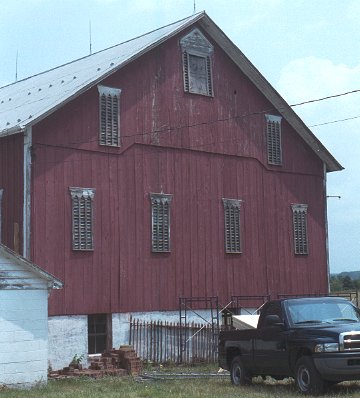
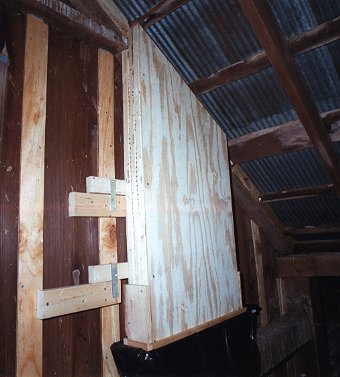
After covering everything in the barn with plastic drop cloths, I built a large bat house to erect on the east wall in the fall of 2000. This was not used (after all, they had the entire barn at their disposal). However, if I can exclude them from the barn this year, they may use this and other large bat houses that will be provided for them. Bat-proofing a barn is no small task. Bats can enter between any two siding boards, as well as any of the numerous ventilators and between each pair of rafters under the eaves. I began restoring the west wall of the bank barn this winter, making it both weather and bat proof. But, I doubt that any new lodging I can provide for them this year will entice them away from their 3000 sq ft hay loft. At least, when I am cleaning up after them, I am reminded that their dung consists of body parts of thousands of moths, beetles and other flying insects.
 August 2001 update - This summer, many of the big brown bats have been spending their mornings in the enclosed roof extension over the south gable end. This location would be both dark and hot compared to the rest of the barn. By early afternoon, they begin to pop out of this enclosure by entering the interior of the barn at various points along the end rafter. The metal roof and rafter are separated by the thickness of the battens, allowing the bats to pass between the barn interior and the enclosed roof overhang between any two battens. When the overhang becomes too hot, the bats enter the barn and crawl down the end rafter to their afternoon roost between a vertical beam and the siding about 15 feet below the peak. The temperature drop with decreasing height in the interior of the barn is dramatic. On a hot sunny day, the temperature near the peak pegs my min/max thermometer at 120 degrees F., while the temperature at the afternoon roost 15 feet below may be only 85 degrees F.
Even though the bats are inside the barn at dusk when they are preparing to leave, many of them tend to reenter the enclosed overhang near the peak and exit the barn through a 1/2" wide gap where the outer rafters join, rather than simply exit through any ventilator or gap in the siding. While about half the bats take this odd route out of the barn each evening, the other half fly to the opposite end of the barn and exit through the various ventilators and other large openings in the north wall. This apparent desire to exit through the smallest opening possible is frustrating to me, since I am trying to bat proof the entire barn. But, the great fun of watching bats is trying to learn why they do what they do.
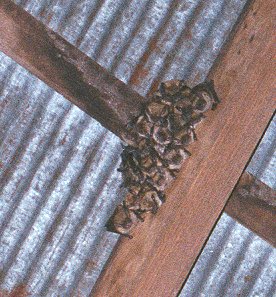 A mystery solved! - For the past two years, large amounts of guano would accumulate on the barn floor at several spots near the center of the barn. I had never seen even one bat above these spots on a rafter or under a roof batten, even with the aid of binoculars. The roof peak is about 30 feet up from the floor. This month, I have been working in the upper barn very late many evenings, putting down flooring and fitting battens to the inside walls. The bats spend a great deal of time inside the barn at night, but never seemed to land on a rafter near one of these mystery sites. Finally one night when I had been working downstairs in the workshop and the bats had the upper barn to themselves, I ventured up into the loft at about midnight to measure a window. While I was doing this, I heard the distinct and continual "tick" of guano hitting the plastic drop cloth under one of these mystery sites. Finally the mystery was solved! a huge mass of big brown bats were clinging to a rafter near the peak, packed together to keep warm. Many of the bats seemed to be clinging to the backs of other bats and the outer layer was in continual motion, perhaps because I was shining a bright flashlight on them. The following three nights were also cool and the bats repeated this phenomenon each night, not in the same exact location, but always near the peak where warm air must have been trapped. On nights when I am working in the barn with lights and loud music, the bats are present, but do not congregate in such an exposed location.
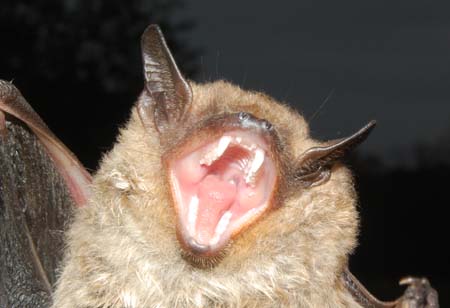
Sept 2001 update - A surprise exodus from the barn to the bat houses - This summer, I have been weatherproofing (and bat proofing) the barn, beginning at the peak of the south gable end where the bats spend the day. Surprisingly, the bats continued their daily routine, even as I continually invaded their space, fitting battens on the inside wall between each vertical siding board and building windows to replace the ventilators. The bats would still leave the enclosed overhang and cling to the end rafter around noon each day, even if I was working within 15 to 20 feet of them. They also didn't seem to mind the loud hammering and sawing and the very loud rock and roll. Only when I approached within 5 to 10 feet of the bats did they react by crawling back into the overhang. There were always one or two bats that would not budge until I approached very close. One of the bravest bats would not budge at all. Only when I approached within 1 foot would he bare his teeth, resembling a winged German shepherd. Big brown bats can bite hard enough to puncture the skin and should not be handled, but are no threat otherwise. They will not attack. I, on the other hand, did accidentally kill two bats. The third day that I worked up near the peak, I noticed the smell of decaying meat and discovered two bats that had crawled under a scaffold plank where it overlapped another plank to spend the day. Stepping on the plank would have squashed the bats. From then on, I had to carefully lift up each overlapping plank from below and check for bats before climbing up to the next level. However, no bats ever crawled under the planks again.
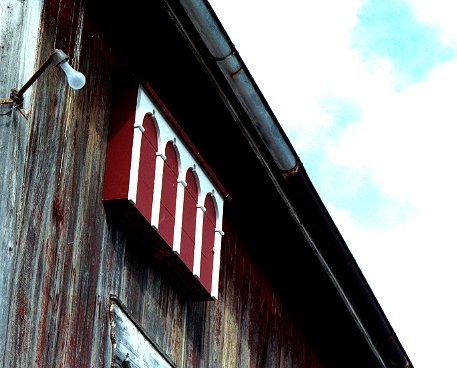
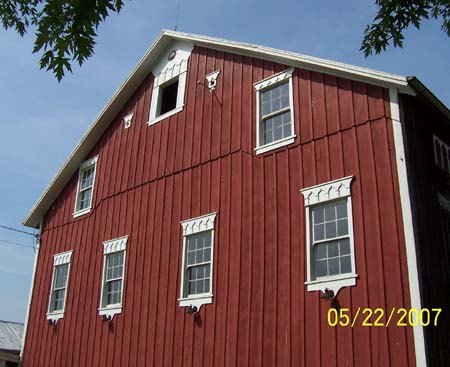 An interior bat house with both outside and inside entrances was mounted on the wall and was immediately used by several of the bats. The interior opening was adjacent to the end rafter where the bats migrated down each afternoon to their cooler roost. I haven't observed the bats using the outside entrance yet, but have found droppings in the bottom tray. This will hopefully be a transitional box. The inside entrance will be closed off as soon as the bats are using the outside entrance. Eventually this box will be removed since it is too close to the future barn owl entrance. All the other bat boxes are on the east wall, where, hopefully, all of the bats will take up residence when the barn restoration is completed. The present transitional box will be replaced with a small apartment for a future male barn owl. The adult owls always roosted in separate flues in the chimney, so I imagine they will appreciate separate, but conveniently close quarters here also.
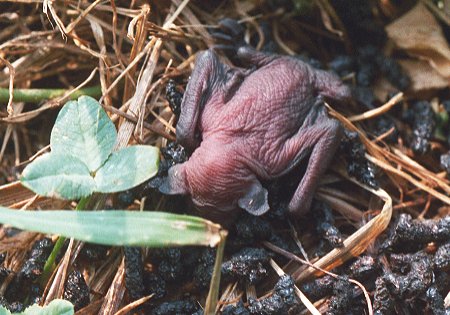
The top half of the wall was battened and the crack at the peak where the bats like to exit was closed. I then began to close off the interior openings to the enclosed roof overhang, leaving enough openings to avoid trapping any bats. Much to my surprise, most of the bats immediately moved out to the two bat houses instead of moving to another site in the barn. I had assumed they would move to the identical enclosed overhang on the north gable end. Most of the bats seem to be using the old bat house which was earlier used as a maternity roost. These are probably the females and juveniles. They use only the rear chamber, which has access to the box's attic. Several bats have been using the large box, but not consistently. Also, as always, individual big brown bats can be found in a variety of locations in the barn. One bat even prefers spending the day alone on our upstairs front porch, sometimes in a crack behind the fascia board and sometimes behind a shutter, but always alone. He has done this for several years.
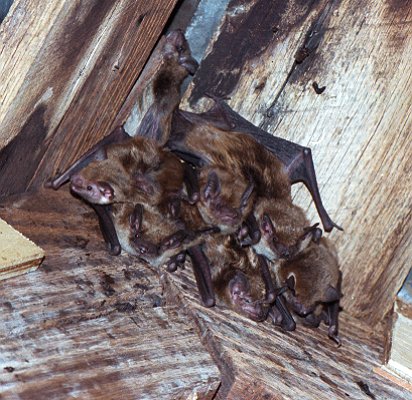 August 2002 Update No further work has been done on the barn this year and the bats have returned to claim the entire structure. A large electrically heated box placed on the east wall only attracted a few males in the spring. As always, the bats move around in the barn a great deal, requiring all the antique machinery and tools to be covered with plastic drop cloths. It seems that no bat house will be a strong enough lure until the barn is completely sealed. At least the bats seem to be thriving in this second year of severe drought. The single big brown is still roosting on our upstairs porch. He must be getting fairly old now.
June 13, 2003 Update EUREKA!! After returning to the barn, as usual, this spring and covering everything with their droppings, the majority of the big brown bats have suddenly moved to the electrically heated bat house! The heated box is being used both for their night and day roost. I haven't cleaned up all their droppings inside the barn, but, it appears that very little is being added. Only after several years of cleaning up 3000 square feet of guano on antique tools and machinery can one appreciate this event. I consider the bats an absolutely essential part of this home habitat and wouldn't harm them for anything, but, this mass exodus from the barn is a welcome relief. The 4 ft wide heated box is recessed in a door way, so I can't stand directly under it to see in the chambers, but from the daily accumulation of guano, it appears to be the maternity colony. When summer heat finally comes to the East, will the bats move back into the barn? I'm hoping not.
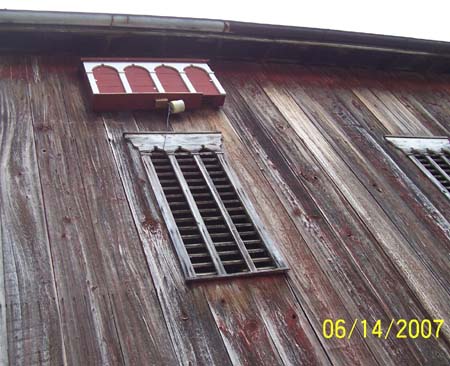
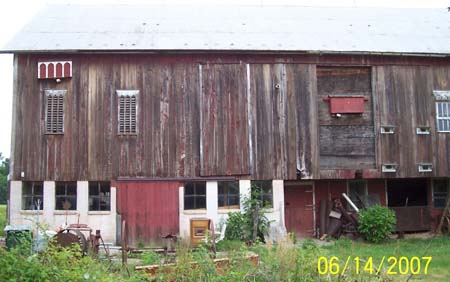
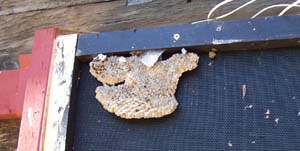
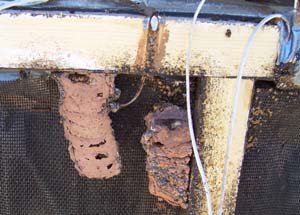
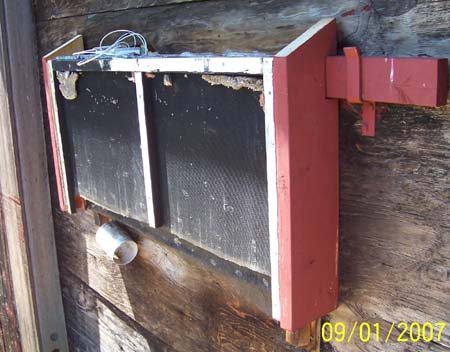 2007 Update - Since 2003, the big brown bats have used both the electrically heated bat box and the other 4' box on the east wall of the barn, as well as roosting under the eaves and behind the porch shutters. They like to move around a lot, perhaps to leave their mites or other parasites behind. However, this year, I had to remove both of the bat boxes to finally renovate the east wall. The heated box was heavy, so I decided it was safer to disassemble the compartments rather than lift the box off the wall. It wasn't going to be reused since it had served its purpose in enticing the bats to desert the barn in 2003. The box had provided shelter for an interesting assortment of wasps and even bees. But, I was surprised to not see any bat parasites. As the compartments were removed, they were dropped off the scaffolding to the ground below. Later, when picking up the plastic screen covered panels, thousands of mites were seen crawling over the entire surface. The tiny mites must have been hiding from the sunlight under the mesh when I examined the panels up on the scaffold. This is likely why I hadn't noticed mites in other bat roosts in the past. The reason big brown bats suddenly change boxes or other roosts, where temperature doesn't seem to be a factor, is thought to be avoidance of a heavy parasite infestation, and now I agree. As for bat lice, of four bats I have examined, all had a single louse on the underside of a wing. Statistically, that means little. I doubt there is a one louse per bat rule.

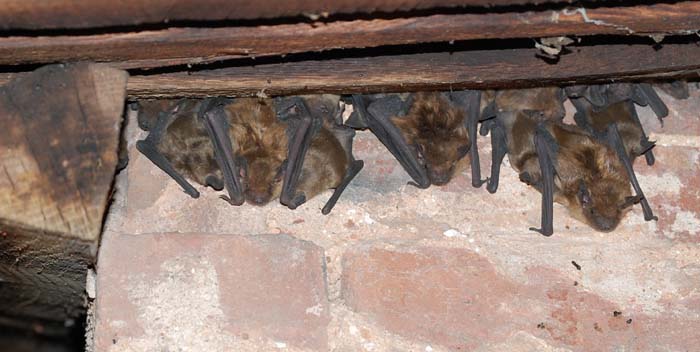 2008 update -
While the big brown bats have not entered the barn this year, they did find their way into the attic of our house. In hot weather, we leave the attic door open for better air flow, which allowed one of the bats to fly down two flights of stairs and immediately be plucked out of the air by one of our cats. One other bat was found upstairs and released out the porch door. At least 30 bats were huddled on a chimney at the roof line. They were gaining access through a small crack in a damaged piece of flashing. Fixing the flashing was easy, but first determining that all the bats were out of the attic took several nights. Now they are back roosting behind the upstairs porch shutters and the barn eaves.
2008 update -
While the big brown bats have not entered the barn this year, they did find their way into the attic of our house. In hot weather, we leave the attic door open for better air flow, which allowed one of the bats to fly down two flights of stairs and immediately be plucked out of the air by one of our cats. One other bat was found upstairs and released out the porch door. At least 30 bats were huddled on a chimney at the roof line. They were gaining access through a small crack in a damaged piece of flashing. Fixing the flashing was easy, but first determining that all the bats were out of the attic took several nights. Now they are back roosting behind the upstairs porch shutters and the barn eaves.
American Artifacts home
email richard@americanartifacts.com
© 2001 - 2012, American Artifacts and Richard Van Vleck, Taneytown, Maryland.