Richard and Diane Van Vleck Personal Pages The Home Habitat |
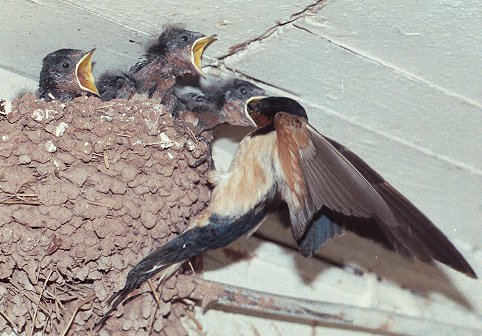
The barn swallow, Hirundo rustica, is found throughout much of the world, and, is resident on all the continents except Antarctica. It is easily distinguished from other American swallows by it's deeply forked tail and rust colored under parts. The barn swallow's aerial maneuvering is unexcelled. It can effortlessly make sharp turns while flying at high speed, enabling it to catch flies and other insects on the wing and in great numbers. When feeding young, barn swallows fly from before dawn until after sunset while taking only infrequent rests. Barn swallows usually nest in small colonies and also hunt together. When a cat or other predator approaches their nesting site, the entire colony immediately mob the intruder in an impressive display of aerial acrobatics. Most of their hunting is done near ground level, over open fields and especially near water. However, often, on late summer afternoons, barn swallows can be seen hunting high in the air. They simply follow the insects, which, in turn, may be reacting to differences in air temperature.
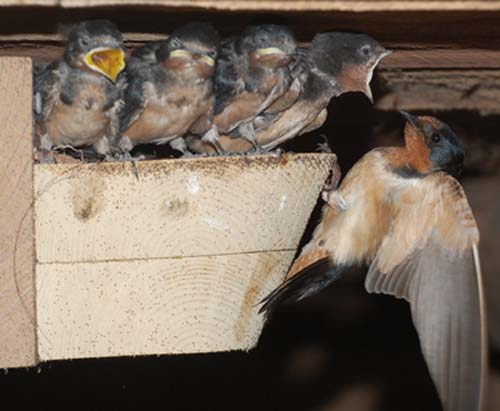 As their name implies, barn swallows usually nest in barns and other outbuildings, as well as under bridges and in culverts. A common species in much of rural America, the barn swallow thrives on the diversified farm. It is generally held in high esteem by the old fashioned farmer, perhaps because, like the farmer, it works from dusk to dawn, and, unlike other birds, but, like the farmer, it chooses to live in a building, and, like the farm family, the entire extended barn swallow family seem to work together. And, of course, farmers appreciate any bird that eats insects and doesn't eat grain. Also, many old fashioned farmers are romantics, and, just enjoy watching these beautiful flyers working above them. Barn swallows will take advantage of any human activity that stirs up insects, whether it is a single person walking through tall grass or a huge noisy machine harvesting wheat. They will flit back and forth following a sickle bar mower cutting hay for hours.
However, the modern farmer is often not the good host that the barn swallows have come to trust. Old barns with easy access are being replaced with large metal equipment sheds with tight fitting doors and no windows. And, massive spraying of fields can put a damper on hunting for insects. When they have five hungry kids in the nest, barn swallows need to catch something every few minutes. They can't wait several days for insects to repopulate.
 All sorts of outbuildings are used by barn swallows, from small sheds to the hayloft of huge barns. The one requirement is that they have access, usually through an open door or window. Simply removing a single 8x10 inch window pane may entice barn swallows to use your shed, but, a larger entrance or two entrances may prove more appealing. The coming and going of even a small colony at nesting time would create quite a traffic jam if all flights were funneled through a single 8" window.
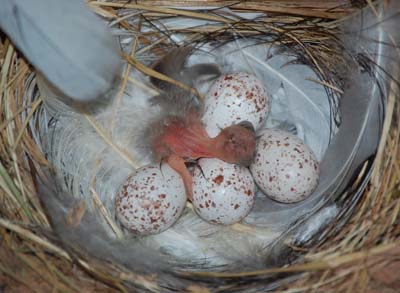
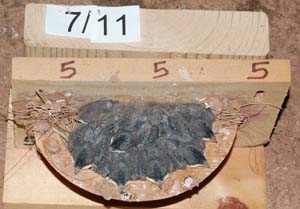
Assuming barn swallows are hunting near your home, the chances of attracting them to nest in your building or on your porch are fair, and well worth the minimal effort required to try. Barn swallows prefer unpainted rough cut wood on which to build their mud nests, since the mud will not adhere well to smooth surfaces. They usually build the nest on a vertical surface just slightly below the ceiling, allowing very little head space above the finished nest. Artificial nest cups are readily used when the interior of the building is painted or planed wood. The droppings of the swallows will be confined to a small area directly under the nest, so take this into consideration when placing the nest cups. However, it is a simple matter to put down a newspaper under each active nest. Fecal sacs are eaten by the parents for the first day or so and then carried off, but, by day 15, the nestlings begin to back up to the edge of the nest and defecate over the edge. Your newspaper will have collected quite a pile of fertilizer by the time the second brood fledges.
 In addition to offering a nesting site, a tray of mud may also be provided directly below the entrance to the building. Nest building is a time consuming process for busy swallows who sometimes have to travel several hundred yards to a stream bank or other source of mud. During dry weather, a tray of mud is easier to keep moist than the conventional technique of hosing down an area of bare ground.
Our swallows incorporate horsehair extensively into their mud nests. If this is not available, they use straw. I wouldn't recommend purposely providing horsehair because instances of birds becoming entangled in horsehair snares protruding from the nests have been reported. I have never witnessed this, but have found numerous loops of hair protruding from the mud nests.
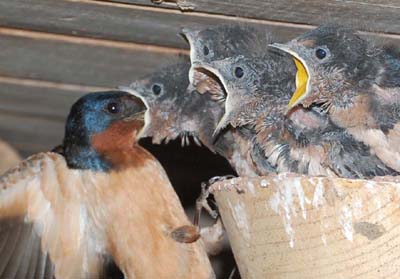 During cold, wet weather, when insects are not flying, swallows can fail to provide enough food for their young. During such weather, insects can be provided in feeders such as previously described for bluebirds (vol 1, No 2, Home Ground). Unlike purple martins, barn swallows are not limited to catching their food on the wing. However, it is more difficult to attract them to a feeder.We also offer crushed egg shells in a jar lid feeder as a calcium source at egg laying time.
If you wish to attract barn swallows to nest in a building that you often enter, such as a work shop, be prepared to alter your activities to allow the birds to adjust to the presence of a human in their home. While the pair are building a nest, entering the building frequently should not bother them, as long as you stay only a minute or two and don't approach the nest. After eggs are laid, the swallows will become quite possessive of their nesting area. They may mob you whenever you enter their room. However, if you ignore them and go about your business, while staying away from the nest, they will quickly get used to your presence. It is important that you do not keep the birds from incubating for more than a few minutes. Also, do not enter the room after dark while the birds are incubating or brooding. If the female leaves the nest and flies outdoors, she may not return until daybreak. Once the adults have accepted you as harmless, you can check nests with no ill effect, especially if you use a mirror rather than climbing up and putting your head close to the nest. There is, however, one more critical stage. When the young are about to fledge, it is best to stop checking the nests. The nestling swallows seem much quieter than many species and won't mind your presence in the room. But, if you climb up and stick your face or hand in the nest, they will quite likely decide to leave the nest, even if it is a day or two before their wings are up to that first flight. It is virtually impossible to then put them back in the nest. The act of putting one back will cause another to leap out. Cats, raccoons, and any other predators that may frequent the outbuilding will be waiting for this opportunity.
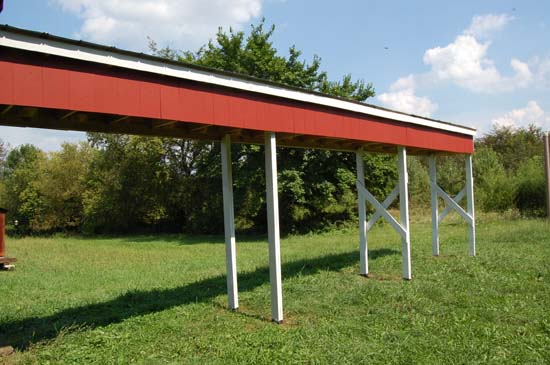 The barn swallow population in our barn grows very slowly from year to year. As many as 70 young are fledged each year, but, only one or two additional individuals appear the following spring. We have no idea how many successfully disperse to other colonies and how many simply don't survive their first migration. Several of our broods often fledge at nearly the same time, and we then see twenty or more fledglings lined up on an electric wire in our yard, waiting to be fed. A second brood usually follows, and immature birds are often seen helping to feed this second brood.
As soon as the last of the second broods fledge, the barn swallows leave our barnyard to spend most of their time hunting near the creek, showing absolutely no interest in the barn where they worked so industriously for the past several months. They drink and bathe on the fly (we call it water skiing), and do most of their hunting over or near the water. The barn swallows seem to enjoy the easy life of late summer, when they do not need to work every minute of the day to feed their young. They are often seen perched above the creek, doing nothing at all. But, the easy life is short lived, as the end of summer approaches and they prepare for their long journey south. We always view their leaving with some trepidation, never being sure that many or any of them will make it back in the spring. The colony in our barn has done extremely well in the past few years. It is rare that an egg does not hatch or a nestling not fledge. Once fledged, we can only guess their survival rate. The nature of the beasts make them difficult to count. We have counted at least 60 barn swallows at one time in August.
The barn swallow has clearly benefited from it's association with humans, however, in doing so, it has put itself in a more vulnerable situation. Humans are a diverse lot; some individuals will gladly cater to the needs of this beautiful species, while others will knock down every nest of a colony and replace the broken glass where they had gained entrance. I imagine all humans look alike to the swallow, and choosing the right barn is just a matter of luck.
Jan 21, 2013 Note: The above was written in 1992. Since then the colony has thrived and much new info has been added. Please check out the other swallow pages.
| barn owl | American kestrel | purple martin | barn swallow | Eastern bluebird |
| tufted titmouse | Eastern phoebe | yellow shafted flicker | tree swallow | chimney swift |
| house wren | big brown bat | Carolina wren | brown thrasher | catbird |
| cedar waxwing | Northern mockingbird | |||
| Yellow warbler | Acadian flycatcher | |||
email richard@americanartifacts.com
© 1992 - 2013, American Artifacts and Richard Van Vleck, Taneytown, Maryland.