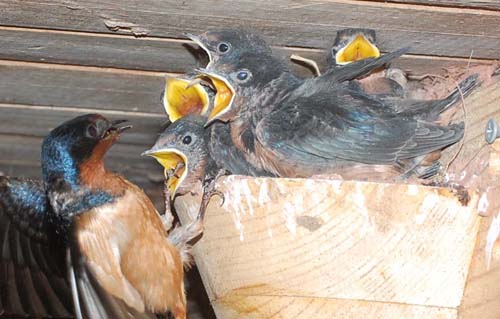
 NEST: Mud nest plastered on beams and walls in old barns and other
 outbuildings and under bridges. Straw or horsehair are incorporated into the nest, which is lined with feathers.
Richard and Diane Van Vleck Personal Pages The Home Habitat |
NEST: Mud nest plastered on beams and walls in old barns and other
outbuildings and under bridges. Straw or horsehair are incorporated into the nest, which is lined with feathers.
EGGS: Usually 4-5, white with brown and lilac spots, .8" long.
INCUBATION: 13-17 days
FLEDGE: 18-23 days
HABITAT: Farmland, marshes, widespread in open country.
DISTRIBUTION: Cosmopolitan species, found on all continents except Antarctica
WHAT YOU CAN DO:
| barn owl | American kestrel | purple martin | barn swallow | Eastern bluebird |
| tufted titmouse | Eastern phoebe | yellow shafted flicker | tree swallow | chimney swift |
| house wren | big brown bat | Carolina wren | brown thrasher | catbird |
| cedar waxwing | Northern mockingbird | |||
| Yellow warbler | Acadian flycatcher | |||
email richard@americanartifacts.com
© 1992 - 2013, American Artifacts and Richard Van Vleck, Taneytown, Maryland.